

You’ve been dealing with bunion pain for a while now. Maybe you’ve already been told you need surgery. But the thought of a large incision, weeks on crutches, and months before you can wear normal shoes again has kept you putting it off.
You’re not alone. That’s exactly why many patients come to Gateley Podiatry looking for a better option.
Dr. Tim Gateley offers the SERI bunionectomy — a minimally invasive approach to bunion surgery that corrects your bunion through tiny incisions instead of the traditional 3-to-5-inch cut. The result? Less pain after surgery, faster healing, and barely visible scars.
If you’re ready to fix your bunion without the long recovery, this page will walk you through exactly how the SERI procedure works, what recovery looks like, and how to find out if you’re a candidate.
What Is a SERI Bunionectomy?
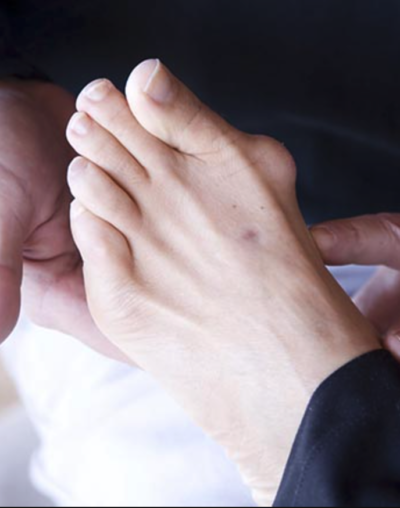
SERI stands for Simple, Effective, Rapid, and Inexpensive — a name that reflects the philosophy behind the technique. It was developed by Dr. Sandro Giannini in Italy and has been studied extensively, with research on over 1,000 cases showing excellent patient satisfaction and long-lasting correction.
Here’s the short version: instead of making a large incision to access and realign the bone, Dr. Gateley performs the surgery through one or two tiny openings — typically just 3 to 5 millimeters. That’s about the size of a pencil eraser.
Because the incisions are so small, there’s less disruption to the surrounding soft tissue, ligaments, and muscles. That translates directly into what patients care about most:
- Less pain after surgery — most patients manage discomfort with over-the-counter medication
- Faster recovery — you can bear weight on your foot the same day, no crutches required
- Minimal scarring — tiny incisions heal to barely visible marks, nothing like the long scar from traditional surgery
- Proven results — decades of research support this technique’s effectiveness and durability
Why Choose Minimally Invasive Bunion Surgery Over Traditional Surgery?
Traditional bunion surgery has been the standard for decades, and it works. But it also comes with a recovery that many patients find difficult to manage — especially if you have a job, a family, or an active lifestyle that doesn’t allow you to be off your feet for months.
The SERI bunionectomy was designed to deliver the same correction with significantly less downtime.
| Traditional Bunion Surgery | SERI Minimally Invasive Surgery | |
|---|---|---|
| Incision Size | 3–5 inches | 3–5 millimeters |
| Weight-Bearing | 6–8 weeks before walking normally | Same day, in a protective boot |
| Back in Regular Shoes | 10–12 weeks | 6–8 weeks |
| Scarring | Significant, visible scar | Barely visible |
| Post-Op Pain | Often requires prescription pain medication | Usually managed with OTC medication |
| Range of Motion | Higher risk of stiffness | Better preserved range of motion |
The bottom line: you get the correction you need and get back to your life faster — whether that means returning to work, exercising, or simply walking pain-free in the shoes you want to wear.
Ready to find out if you’re a candidate? Call 785-730-3478 or Request an Appointment to schedule your consultation with Dr. Gateley.
Am I a Candidate for Minimally Invasive Bunion Surgery?
The SERI bunionectomy is an excellent option for patients with mild to moderate bunions who want effective correction without a lengthy recovery.
You may be a good candidate if:
- Bunion pain is limiting your daily activities or making it hard to find comfortable shoes
- You’ve tried conservative treatments like wider shoes, padding, or orthotics without lasting relief
- You want to avoid extended time off work and a long recovery
- You’re looking for a surgical option with minimal scarring
What if your bunion is more severe? That doesn’t mean surgery isn’t an option — it may just mean a different surgical approach will give you a better result. Dr. Gateley performs a full range of bunion correction procedures, from minimally invasive techniques to more traditional approaches for complex cases. The goal is always to match the right procedure to your specific situation.
The only way to know for sure is through an in-person evaluation. Dr. Gateley will examine your foot, review weight-bearing X-rays, and have an honest conversation about which approach will give you the best outcome.
Contact us at (785) 730-3478
Gateley Podiatry | Excellence in Medical & Surgical Treatment of the Foot & Ankle | Topeka, Kansas
What Happens During SERI Bunion Surgery?
Knowing what to expect can take a lot of the anxiety out of surgery day. Here’s how the process works at Gateley Podiatry.
Before Surgery
Dr. Gateley will see you for a pre-operative consultation to review the surgical plan, answer your questions, and make sure you’re medically cleared. You’ll receive detailed instructions about how to prepare — what to eat, what medications to adjust, and what to bring on surgery day.
During Surgery
The SERI bunionectomy is an outpatient procedure, which means you go home the same day. The surgery itself typically takes 30 to 45 minutes.
You’ll receive a local anesthetic block that numbs your foot and ankle, usually combined with light sedation so you’re relaxed and comfortable. You won’t feel pain during the procedure.
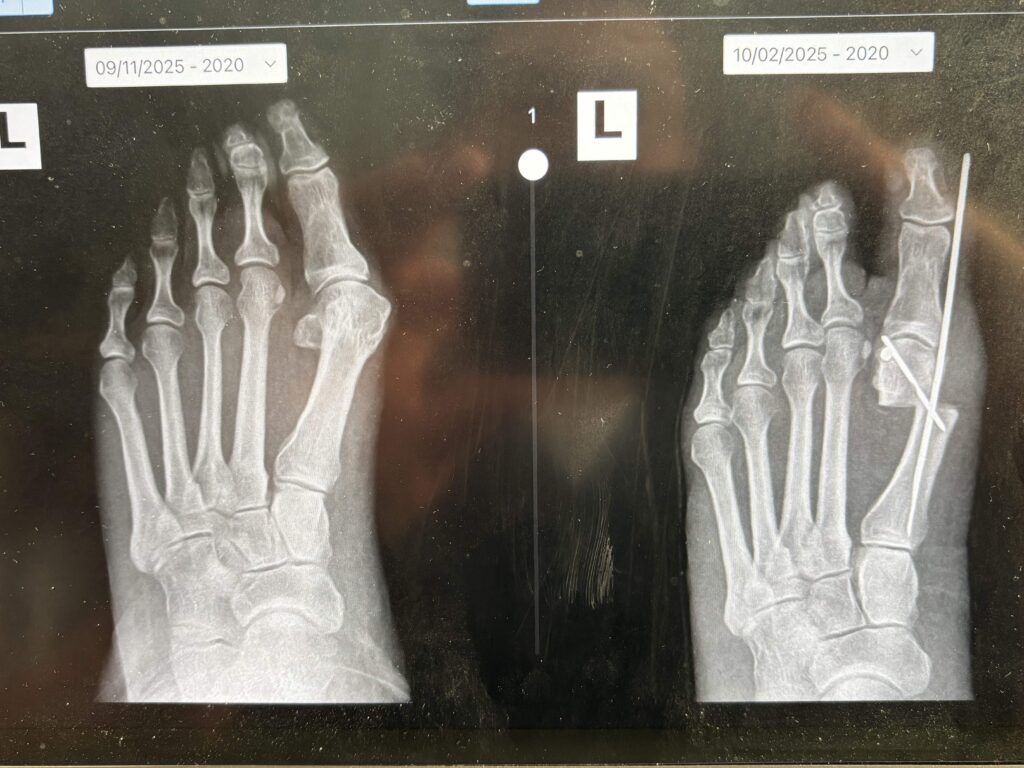
Dr. Gateley makes several tiny incisions — about the size of a pencil eraser — to access the bone. Using specialized instruments, he carefully cuts and repositions the bone to correct the alignment of your big toe. Depending on your case, the bone is secured with 2 pins to allow the bone to heal in its corrected position.
Because the incisions are so small, there’s minimal disruption to the soft tissues around your toe joint. That’s the key reason patients experience less swelling and less pain compared to traditional surgery.
After Surgery
Your foot is bandaged and placed in a protective post-operative boot. After a brief recovery period, you’re ready to go home.
You’ll need someone to drive you, since you shouldn’t drive for at least 24 hours after anesthesia.
What Is Recovery Like After SERI Bunion Surgery?
One of the biggest advantages of the SERI technique is a faster, more manageable recovery. Here’s a realistic timeline of what to expect.
Weeks 1–2: Early Recovery
Some pain, swelling, and bruising are normal — but most patients describe the discomfort as manageable with over-the-counter pain relievers. You can bear weight on your foot right away in a protective post-operative boot. Plan to rest and elevate your foot as much as possible to keep swelling down.
Dr. Gateley will see you during this period to check your incision, change the bandages, and make sure healing is on track.
Weeks 3–6: Getting Back to Normal
Pain and swelling continue to improve. You’ll still wear the protective boot, but you can gradually increase walking and light daily activities. Most patients with desk jobs return to work during this phase.
Sutures (if used) are typically removed around day 10 to 14, and Dr. Gateley will take X-rays to confirm the bone is healing properly.
Weeks 6–8: Transition to Regular Shoes
This is when most patients can move back into supportive athletic shoes. Swelling decreases significantly, and you’ll have much more mobility and comfort. You can resume most normal daily activities, though high-impact exercise like running or jumping should wait a bit longer.
Weeks 8–12: Full Recovery
For most patients, pain and swelling are minimal or gone entirely by this point. You can return to all normal activities — including exercise, sports, and yes, wearing the shoes you love.
Your recovery timeline may vary depending on your age, overall health, and how closely you follow post-operative instructions. Dr. Gateley will give you a personalized recovery plan based on your specific situation.
Frequently Asked Questions About Minimally Invasive Bunion Surgery
Why Choose Dr. Gateley for Minimally Invasive Bunion Surgery in Topeka?
When it comes to surgery on your feet, you want someone who’s done this before — many times — and who stays current with the latest techniques.
Dr. Timothy Gateley is a board-certified podiatric surgeon who has been performing bunion surgeries for over 20 years. He’s trained specifically in the SERI minimally invasive technique and has performed hundreds of successful bunion corrections throughout his career.
But what his patients consistently tell us goes beyond credentials:
He takes the time to explain your options. You’ll never feel rushed or pressured. Dr. Gateley walks through your X-rays, explains exactly what he sees, and lays out all your options — including non-surgical ones — so you can make an informed decision.
He’s honest about what you need. Not every bunion requires surgery, and Dr. Gateley will tell you that directly. If conservative treatment can solve your problem, that’s what he’ll recommend. Surgery is reserved for when it will genuinely improve your quality of life.
He’s here for the long haul. Gateley Podiatry isn’t a surgical mill. Dr. Gateley and his team follow you through every stage — from your first consultation through your final recovery visit — to make sure you get the result you deserve.

Take the First Step Toward Pain-Free Feet
You don’t have to keep living with bunion pain. And you don’t have to dread a long, painful recovery to fix it.
If you’ve been putting off bunion surgery because you’re worried about the downtime, the SERI minimally invasive bunionectomy might be exactly what you’ve been waiting for.
Schedule your consultation with Dr. Gateley to find out if you’re a candidate.